Wednesday, September 25, 2013

Mindset matters

Q. You have worked across sectors. What are the biggest HR challenges that you have come across?
A. HR challenges are similar across sectors. It all depends on what phase of time you work in that particular sector. Typically, talent retention and development remain one of the biggest challenges.

Q. How different has been the experience of working with SPX?
A. SPX Corporation is an NYSE-listed Fortune 500 U.S. multinational company. The organisation has a much focused approach on employee life-cycle management. This has made the work very exciting.

Q. What is the biggest barrier in training new technologies to people?
A. The greatest barrier is the mindset of the team’s manager and the focus of the organisation.

Q. What is your dream accomplishment? How do you intend to achieve it?
A. It is to lead an organisation to new heights while its focus remains on the people. And I am on my way.

Q. One trait an HR leader must possess?
A. Every HR leader must have adaptability.

Q. Who is your role model?
A. There are many role models and it would be unfair to name one. Click here to read full interview...

Like us and read IIPM Think-Tank articles on facebook

Labels: , , , , ,

Thursday, August 01, 2013

Globalisation and IR an interview with Prof. Mirella Baglioni (university of Parma, Italy)

Please tell us the significance of industrial sociology in a globalised world?
A. Sociology maintains its importance, as sociological research helps in understanding the changes taking place in a globalised world. This holds true in defining what society is today, what remains of the nation-state identity and what contribution does the global exchange of information and communication provide to define new cultural identities.

Q. How would you define the strengths and weaknesses of collective bargaining in Europe?
A. Collective bargaining at the national level has a role of defining minimum standards in a number of European member states. However, if we look at EU 27, the role of collective bargaining in regulating wages and working conditions varies to a great extent.

Q. Do you see European integration and IR together in a globally competitive environment?
A. The aim of European integration, where single market and a single currency could be accompanied by a progressive harmonisation of social rights, is nowadays progressively weakening. In the ideal social Europe, IR played a key role as social partners were regarded the main representatives of economic and social interests. At global level, rising number of transnational agreements bear witness to unions’ initiatives towards strategies of internationalisation, but changes in social partners’ strategies take time. Click here to read full interview....

Like us and read IIPM Think-Tank articles on facebook

Labels: , , , , ,

Saturday, July 20, 2013

The right perspective

In a fast-growing corporate arena, it is essential that HR professionals adapt themselves to the changing demands of management, break away from traditional strategies and experiment with innovative methods and practices, to lay down the foundation of a productive workplace, said experts at the Annual HR Conclave organised by IIPM on August 11, 2012 at Hyderabad.

The conclave aimed at presenting the views of some of the eminent experts on ‘Competencies of a Successful HR Professional in Today’s Changing Scenario’. The conclave also saw a good participation of representatives from HSBC, Yes Bank, Rofus, Perfect Relations, Diebold, Google, The Golkonda Hotel, ManpowerGroup, Deloitte, GMR, Winzest, CBay, Netzworke, Shore Infotech and Dupont, to name some.

Mr. Debasis Chatterji, CEO, Netxcell Ltd, said that development of competencies for various functions of HR helps the management of an organisation with strategy execution. He also focused on business operations and how to be a good business partner, locally and globally.

Mr. Venkatesh Palabatla, chief HRO, GMR Group, emphasised on how to develop competencies to reduce cost of operations without losing talent. Ms. Rajita Singh, head HR, Broadridge Financial Solutions, focused mainly on how HR professionals should attain, retain and motivate employees. She also threw light on some new and innovative ideas that many organisations are incorporating today to motivate their employees.

IIPM faculty member and head, Strategic Management Group, Prof. Rajat Shukal elaborated on the trend of outsourcing measure. He said that global trends indicated a growth of 37 per cent per annum in this sector. Prof. Shukal also shared demographic analysis of future manpower. Click here to read more...

Read More IIPM Related Articles
Zee Business Best B-School Survey 2012
Prof. Arindam Chaudhuri's Session at IMA Indore
IIPM IN FINANCIAL TIMES, UK. FEATURE OF THE WEEK
IIPM strong hold on Placement : 10000 Students Placed in last 5 year
IIPM's Management Consulting Arm-Planman Consulting
Professor Arindam Chaudhuri - A Man For The Society....
IIPM: Indian Institute of Planning and Management
IIPM makes business education truly global
Management Guru Arindam Chaudhuri
Rajita Chaudhuri-The New Age Woman
IIPM B-School Facebook Page
IIPM Global Exposure
IIPM Best B School India
IIPM B-School Detail
IIPM Links
IIPM : The B-School with a Human Face

Labels: , , , , ,

Thursday, February 28, 2013

Educational institutions should shift focus from a marks-oriented system to THE one that fosters social responsibility and awareness, SAYS N.C. Wadhwa (Vice- Chancellor, Manav Rachna International University)

How can we then impart good education to students at the highest levels to ensure it is worthwhile and goal-oriented? Institutional excellence can only occur in a student-centric environment. Moreover, no borrowed system can make students self-assured and confident. For the latter, it is necessary that the structures and systems are firmly anchored in our rich cultural heritage. This has to be the foundation of all educational institutions that endeavour to produce self-assured and socially conscious students. In imparting education, a student-centric university should not just focus on disseminating knowledge and mere ‘knowing’ of analytical knowledge. Rather, the focus should be on ‘doing’ or development of skills and ‘being’ or a sense of purpose and identity.

Towards this end, the pedagogy that institutions follow – particularly for management students – should be based upon the belief in multiple intelligence and through the use of diverse teaching methodologies. Both teachers and students should be co-learners. Here, teachers should facilitate learning rather than teach according to the ‘banking concept’ where one is the receiver and the other is the giver. Students should be taught through experiential methods such as live field projects, workshops, action research, simulations, prototyping, role-playing scenarios, socio-drama/psycho-drama, drama, dance, meditation, case studies, seminars, industry interface and guest lectures, mentoring, and suchlike.

Students can maintain a daily diary in every semester, documenting their experiences and lessons learnt. Finally, there is the unique Four–tier mentoring programme; here students can be mentored by the industry, peers, faculty and alumni, which makes students’ rite of passage from the university into the corporate world smoother. Click here to read more...

Read More IIPM Related Articles
Zee Business Best B-School Survey 2012
Prof. Arindam Chaudhuri's Session at IMA Indore
IIPM IN FINANCIAL TIMES, UK. FEATURE OF THE WEEK
IIPM strong hold on Placement : 10000 Students Placed in last 5 year
IIPM's Management Consulting Arm-Planman Consulting
Professor Arindam Chaudhuri - A Man For The Society....
IIPM: Indian Institute of Planning and Management
IIPM makes business education truly global
Management Guru Arindam Chaudhuri
Rajita Chaudhuri-The New Age Woman
IIPM B-School Facebook Page
IIPM Global Exposure
IIPM Best B School India
IIPM B-School Detail
IIPM Links
IIPM : The B-School with a Human Face

Labels: , , , , ,

Monday, February 04, 2013

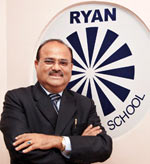
Dr. Augustine F. Pinto (Founder Chairman, Ryan International Group of Institutions) emphasises on quality education as the pillar for a country like India to progress and prosper, providing skilled labour to business

Q. Of late, we have experienced instances like a student killing his teacher, teachers inflicting corporal punishment on students. How do you see the changed teacher-student relationship? Can BEd, MEd and other teacher-training programmes make a difference?
A. It is certainly not acceptable if schools are still practising corporal punishment; they immediately need to change that. It is true that the role of a teacher has radically changed over the years but that does not mean teachers and schools should indulge in corporal punishment. Simultaneously, instances of students killing or attacking their teachers require a thorough observation about the students’ emotional quotient and other related factors before jumping to any conclusion.

The primary aim of education is to lead students to ‘self-actualisation’ and should be concerned with the overall development of children – physical, intellectual, emotional and spiritual. It is a transformative learning process where a teacher becomes a friend, a mentor, a facilitator, or an experienced travelling companion who persuades students to develop their own learning styles through appropriate integration of technology as required and hands-on learning and helps them become responsible and balanced citizens. Introducing teachers to this reality during their teacher-training programme will definitely create an atmosphere that will foster positive relationship between teachers and students for better teaching and learning experience.

Q. As an institution, what is Ryan International doing to motivate its teachers? How do you assess its impact?
A. The Ryan way is defined as KASSM – knowledge, attitude, skills, social and morals. Values with sound knowledge and the wisdom to use it constructively is what provides the differential factor to our students at Ryan.

Our teachers are regularly sent for various workshops, training programmes and in-house seminars to become proficient in discharging their responsibilities.

Regular guidelines from the management team also keep teachers aware of their significant role in the process of education. Success stories of our students and overwhelming support from parents and the stakeholder vividly speak about their positive impact on the entire process. Click here to read full interview...

Read More IIPM Related Articles
Zee Business Best B-School Survey 2012
Prof. Arindam Chaudhuri's Session at IMA Indore
IIPM IN FINANCIAL TIMES, UK. FEATURE OF THE WEEK
IIPM strong hold on Placement : 10000 Students Placed in last 5 year
IIPM's Management Consulting Arm-Planman Consulting
Professor Arindam Chaudhuri - A Man For The Society....
IIPM: Indian Institute of Planning and Management
IIPM makes business education truly global
Management Guru Arindam Chaudhuri
Rajita Chaudhuri-The New Age Woman
IIPM B-School Facebook Page
IIPM Global Exposure
IIPM Best B School India
IIPM B-School Detail
IIPM Links
IIPM : The B-School with a Human Face

Labels: , , , , ,

Monday, December 03, 2012

A human asset management tale

Human Resource Management has been a great success at Tata Consultancy Services, Asia’s largest provider of information technology. The management has always believed that “HR is the greatest asset that any organisation possesses and it must ensure that this potential is harnessed to the maximum to contribute positively towards the growth of the organisation.”

TCS is a part of India’s largest and oldest conglomerates, the TATA Group. It has evolved various HR models and methodologies which have enabled it to be successful and carry forward the legacy of its founders. TCS employees are recognised as intellectual fuel and are provided with various benefits which are designed to retain them.

S. Ramodaorai, who remained its CEO from September 1996 to October 2009, played an integral role in the international development of TCS. He took over when TCS earned USD 400 million and had 6,000 employees. His efforts have helped make TCS one of the world’s largest global software and service companies with more than 1,43,000 consultants working in 42 countries, operating out of over 151 offices worldwide, and with revenue over USD 60 billion.

Labels: , , , , ,

Monday, November 26, 2012

Shalini Kamath (managing Director, HR & Communications, Ambit Holdings Pvt. Ltd.) says a collaboration between business and HR can expose many untapped solutions which could be more appropriate for the business

Q. Can HR do the damage control? Does it hold the power to mitigate a negative?
A.
With most turnaround cases it is observed that the trust on the business is either not established or has deteriorated due to certain misgivings in the past. HR has the ‘connect’ with employees and can act as the trustworthy intermediary that can assist the turnaround.

Effective communication by the business and HR collectively works the best towards damage control or mitigating a negative. An open and transparent communication helps the employees to understand what critical juncture the organisation is currently in; what are the benefits of a turnaround; and what are the people concerns that can be resolved and the ones that cannot.

Q. What major challenges are associated with a turnaround in the service sector?
A.
The major challenge is to influence the people who come with their own set of thinking, behaviour, and cultural and economic influencers. Changing the mindset of intellectual workers is quite difficult, since a lot of reasoning and logic are required so that they do not resist the turnaround. Making those workers accept change also requires a lot of patience and it takes time. Expecting a turnaround to happen in a short span is fallacious.

Q. What is the new thinking during recruitment and talent retention during a turnaround?
A
. If the talent pool believes what is being practised by the company is going to be beneficial for all and will result in success then there would not be too many people who would like to leave, and retention may not be a major issue. However, if the initial stages are not handled well, the threat of attrition could loom large.

Either organisations should recruit the key people required for the turnaround before they commence the process or they should hold recruitment of critical staff unless it is extremely necessary. Read more..

Labels: , , , , ,

Thursday, November 22, 2012

The people custodian

Q. Your partnership with Great Place to Work ® Institute identified ‘India’s Best Companies for Rewards and Recognition 2012.’ What makes an office a great place to work?
A. It happens when most of the following are taken care of:
• An organisation should encourage L&D opportunities which also helps employees achieve individual aspirations and eventually build an emotional connect with the firm.
• Companies must deliver an experience to employees, be it providing with the right infrastructure that helps them perceive the workplace as a home away from home.
• With top management focusing on accessibility and accountability, an organisation should foster culture of an employee-friendly organisation.
• Strong appreciation culture with market aligned compensation structure is essential for a great place to work.

Q. How can the CEO-HR partnership achieve this vision?
A. A CEO is also the people custodian and sets along with the leadership and HR chief the HR vision and priorities of the firm. He then ensures execution happens in complete alignment. The CEO is also the visionary of the organisation so once the vision is defined, all people practices should be aligned to it and larger goals of the organisation. Read more...


Read More IIPM Related Articles
Zee Business Best B-School Survey 2012
Prof. Arindam Chaudhuri's Session at IMA Indore
IIPM IN FINANCIAL TIMES, UK. FEATURE OF THE WEEK
IIPM strong hold on Placement : 10000 Students Placed in last 5 year
IIPM's Management Consulting Arm-Planman Consulting
Professor Arindam Chaudhuri - A Man For The Society....
IIPM: Indian Institute of Planning and Management
IIPM makes business education truly global
Management Guru Arindam Chaudhuri
Rajita Chaudhuri-The New Age Woman
IIPM B-School Facebook Page
IIPM Global Exposure
IIPM Best B School India
IIPM B-School Detail
IIPM Links
IIPM : The B-School with a Human Face

Labels: , , , , ,

Thursday, November 01, 2012

WILLIAM GREENHALGH CEO, HUMAN RESOURCES PROFESSIONALS ASSOCIATION

William (Bill) Greenhalgh has a strong background in nuclear engineering, petroleum, telecommunications, publishing, entertainment, and security industries. He has served as president, the Globe and Mail; president, Cinram International; COO, Shred-it International, and handled various roles at Nortel. Greenhalgh has been instrumental in crafting fundamental visionary changes in HRPA’s strategic direction.

Q. What are the key issues you want the HR to understand?
A. Any senior HR executive needs to be a business person first and an HR leader second. He should have a comprehensive understanding of the business: the nature of the business; its challenges and opportunities; who the customers are and their challenges; and who the competitors are.

HR executives also require an understanding of challenges and business needs of supervisors and front-line managers on a first-hand basis. They need to forecast critical social, legislative and people trends; leading the organisation in implementing programmes that have front-line buy-in. They need to be the CEO’s trusted advisor and be a coach to the executive team.

Q. As a CEO, what do you expect from HR in terms of understanding the business?
A. HR executives bring the people dimension to the organisation’s strategy. Creating a strategy is important and executing it is vital; how well that is done depends on having the right people, culture, training and compensation. Those programmes are part of HR’s role, so it has to be a part of the creation of the strategy and plans to implement it. For this, HR needs to understand how the business works, the market, and the challenges and competition it faces.

CEOs also feel that HR executives – more than any other senior executive – should have the capability to build trust, communicate and collaborate with others with exceptional levels of diplomacy and discretion. These attributes must co-exist, however, with a deep understanding of the business – a strong grasp of the business’ operations and financial realities – and its algorithms and P&L. Click here to read full interview...

Read More IIPM Related Articles
Zee Business Best B-School Survey 2012
Prof. Arindam Chaudhuri's Session at IMA Indore
IIPM IN FINANCIAL TIMES, UK. FEATURE OF THE WEEK
IIPM strong hold on Placement : 10000 Students Placed in last 5 year
IIPM's Management Consulting Arm-Planman Consulting
Professor Arindam Chaudhuri - A Man For The Society....
IIPM: Indian Institute of Planning and Management
IIPM makes business education truly global
Management Guru Arindam Chaudhuri
Rajita Chaudhuri-The New Age Woman
IIPM B-School Facebook Page
IIPM Global Exposure
IIPM Best B School India
IIPM B-School Detail
IIPM Links
IIPM : The B-School with a Human Face

Labels: , , , , , , ,

Thursday, October 25, 2012

Anisha Singh (Founder and CEO, mydala.com) reveals to Schweta Chaturvedi how self-belief Diminishes The Line between Dream and Reality

Continued....Mrs. Singh, who is also associated with Indus Women Entrepreneurs– a platform for South-Asian women leaders in the US– discovered her potential when she was in the US. “During internship with the Olympus Group, I was completely in awe of the lady who used to run it. This made me realise that everybody should have a role model to look up to,” says Mrs. Singh and affirms that women can do a lot if they challenge themselves and set their heart and mind to it.

Sharing the initial challenges, Mrs. Singh says that the first two years were difficult because there was a need to educate merchants and users about the concept and benefits of group buying. “The merchants would say ‘go to hell’ if we went to them asking for a 90 per cent discount.” It was after a lot of perseverance that the idea finally clicked and the proposal started taking some shape. Mydala’s mantra is: The customer is King! Or Queen! And Mydala treats its customers the way they like to be treated, she shares.

Starting with a small team of four, the Mydala.com now has close to 50 people spread across India. Ask her how she goes about hiring the right people and she replies, “We have been fortunate enough to have good advisors. Good talent might come by harder, so you have to be patient.” Mrs. Singh also makes it a point to hire young people who are passionate about giving hundred per cent to their job. click here to read more....

Read More IIPM Related Articles
Zee Business Best B-School Survey 2012
Prof. Arindam Chaudhuri's Session at IMA Indore
IIPM IN FINANCIAL TIMES, UK. FEATURE OF THE WEEK
IIPM strong hold on Placement : 10000 Students Placed in last 5 year
IIPM's Management Consulting Arm-Planman Consulting
Professor Arindam Chaudhuri - A Man For The Society....
IIPM: Indian Institute of Planning and Management
IIPM makes business education truly global
Management Guru Arindam Chaudhuri
Rajita Chaudhuri-The New Age Woman
IIPM B-School Facebook Page
IIPM Global Exposure
IIPM Best B School India
IIPM B-School Detail
IIPM Links
IIPM : The B-School with a Human Face

Labels: , , , , , , , , ,

Monday, October 08, 2012

Next G8: Star Cruise

The summit will also include paragliding, water sports, bungee lessons

With passing time, experts now concur that French premier, and (hyper)active G8 member Nicholas Sarkozy has started looking – and behaving – eerily similar to Sylvester Stallone [Go ahead, give it a try; identify sweet Nick in the photograph]. Funnily, this behavioural similarity extends to the whole G8 belt [US, Japan, Germany, France, UK, Canada, Italy, Russia and Ethiopia... er, alright, if you caught us on this, read on, you seem to be interested], with almost every member contributing his Shylockian best to behaving like a spoilt celebrity during every summit, finally achieving nothing. So we did what we do best [no no, not that; Bush does that better] – we analysed the progress report of the past few summits to decipher what exactly has been achieved in terms of contribution to least developed nations!

G8 summit in Birmingham, England, 1998: Protesters for the first time were formally allowed to give a written letter, which requested G8 to work on the heavy debt burden of the third world. Letter accepted, case dismissed! Nothing much was discussed, leave of course the letter. Cologne, Germany, 1999: To prove that they were worried about poverty, an ‘officially’ undisclosed amount was sanctioned. According to World Bank, the ‘sanction’ was so small that it wasn’t enough to even provide five bread loaves per person per year per poor country. Okinawa, Japan, 2000: Aid amount invested in projects: Close to nil; evidently because of billions spent on militarisation of north-east Asia. Genoa, Italy, 2001: Progress on debt cancellation: Nil! Massive protests took the blame, rather than the G8 members.

Kananaskis, Canada, 2002: Among many important issues, NEPAD [New Partnership for Africa’s Development] was also on agenda. $64 billion was requested, but only $6 billion was sanctioned. The reason? Russia requested – and was presumably given – $20 billion for the upkeep of the Russian nuclear stockpiles.

Source : IIPM Editorial, 2012.

For More IIPM Info, Visit below mentioned IIPM articles.

 
IIPM : The B-School with a Human Face

Labels: , , , , , , , , , , , , , , , ,

Saturday, October 06, 2012

“TRAI Can’t Force QOS norms on Operators”

Satyen Gupta, former Principal Advisor, TRAI

Telecom Regulatory Authority of India (TRAI) played a pivotal role in the great Indian telecom success story. The body keeps a close watch on the quality of services offered by the telecom operators to millions of wireless subscriber. However, there is little that the regulator can do when it comes to implementation of these norms on the ground level. Former Principal Advisor to TRAI Satyen Gupta spoke to Akhilesh Shukla about the MNP and regulators role in implementation of QoS norms.

B&E: The churn rate in India is very high, especially in the prepaid segment. Do you think MNP would be able to further escalate the churn rate?
Satyen Gupta (SG):
Truly speaking, MNP would not have a major impact on the churn rate in the telecom space. The little churn that we could see would be on the front of high value postpaid subscribers. Most of them are corporate executives or business class people, who need to be connected 24x7. These people need quality service. They have all the reasons to port if they are dissatisfied with the existing service provider. The service provider has to make investments to retain them; otherwise they will see a decrease in top line.

B&E: How would the implementation of MNP impact the service providers?
SG:
The marketing budget of telecom operators would significantly go up after the roll out of MNP across the country. The operators have to communicate and educate subscribers about its USP at regular intervals to remain competitive. Investment has to be made on the front of improvement and maintenance of QoS. At the same time, they have invest in retention of dissatisfied subscribers, especially high ARPU ones.

B&E: 3G and MNP were expected in India for quite a long time. Do you think the delay had any negative impact on the sector?
SG:
The delay of both the services did not have much impact on the Indian telecom sector. Both the services were present in one form or the other. People looking for high speed connection while on move have already subscribed to EDGE services (2.75 G) for the handset. Similarly, high speed data cards, offered by the CDMA operators, have fulfilled the need for faster internet on mobile platform. Similarly, the dual SIM phones have bridged the gap for subscribers looking for a new operator while retaining the existing number.


Source : IIPM Editorial, 2012.

For More IIPM Info, Visit below mentioned IIPM articles.

 
IIPM : The B-School with a Human Face

Labels: , , , , , , , , , , , ,

Friday, October 05, 2012

How Late is Too Late for Toyota?

Etios can prove to be a Fortune Changer for Toyota in the Indian Market. But there are Challenges Galore that are Hell-Bent on Proving why the Jap’s Slow-Coach Small-Car Strategy may work Against It.

Early this year, Akio Toyoda, the chieftain of Toyota became the bad guy for doing the right thing – recalling 8.5 million vehicles over safety concerns. First, he was abused across continents. Then, after being verbally clobbered by the US Congress, he was slapped a fine of $16.4 million. Beat his audacity – Toyota paid the fine without submission of any wrongdoing on May 18, 2010. Since then, there have been (f)acts that have gone much against popular expectations. First, the Japanese carmaker announced a fresh round of recalls on November 4, 2010 (of 135,600 Passo and iQ cars in Japan and Europe to fix the vehicles’ power-steering system). Second, Toyota’s financials have remained sound despite the pepper sprays. During the first half of a trouble-marred 2010, the company sold 3.72 million vehicles worldwide – an increase of 18.7% as compared to the same period a year back. As far as earnings were concerned, it recorded an unexpected 15.5% y-o-y rise in topline to touch $117.45 billion during H1, 2010, with bottomline improving drastically (from a loss of $679 million during H1 2009, to $3.51 billion). There was more good news to follow.

While the company’s m-cap remains close to the $120 billion mark (the same as it was 12 months back), the investors have found a new reason to smile about. On November 5, 2010, the company announced an increase in net income target for FY2010-11 to $4.3 billion. The secret – as experts agree – is Toyota’s new low-cost model for emerging markets, which begins with the Etios launch in India in early December 2010.

Many suggest that Etios may face the same fate as the Toyopet did way back in 1957, when Toyota tried to introduce it in US. The suffix “pet” suggested that it was the small, compact sedan that Americans were yearning for. What followed however, was shocking. In three years, the Toyopet had sold only 1,913 units and the company was forced to withdraw the failed car from US. The sentiment in India is similar today. In the present times, it is understood that a compact car (the A2 segment) is likely to work wonders in the Indian auto market. For the records, 72.8% of the 9,22,281 units of passenger cars sold in India till September during FY2010-11, belonged to this very segment. So can the Etios do for Toyota what the Altos and the Swifts did for Maruti or what the Santros and i10s did for Hyundai? Etios is the next big step which can establish Toyota’s dominance globally, and for a long time to come. Call it clever, but it starts with the toughest of acid tests – convince the Indian consumer. But the biggest question is – can it?

To imagine that the magic could happen overnight would be foolish. While Maruti today accounts for 55.03% of the sales in this category, having sold 369,466 units in the A2 segment during Q1 & Q2, FY2010-11 alone, the #2 Hyundai has 22.74% of the segment, with sales of 152,664 units during the same period. More so, both have been celebrated brands for over two decades for the price-sensitive Indians. Toyota on the other hand, is simply recognised as a brand in just the Rs.1 million-plus bracket, which includes the A4 segment (where it holds an 18.99% share; data for Q1-Q2, FY2010-11) and the Utility Vehicle (UV) segment (22.31% share). And even if Toyota manages to challenge the might of the Marutis and the Hyundais in the sub-Rs.0.5 million platform, finding the right price level, while maintaining decent margins will pose a challenge to Toyota, as Hiroshi Nakagawa, MD, Toyota Kirloskar confesses to B&E, “Pricing will surely play a very strategic role in the success of the compact car Etios, as convincing the value-conscious Indian consumer is the toughest task in the world.”

But if the Spark & Beat could save GM’s day in India, and if Figo could come to broaden Ford’s consumer base, why discount out Toyota? Out of the 46,603 units sold in India by GM during the past two quarters, 74.52% belonged to the A2 segment. And of the 48,002 units sold by Ford India, 79.54% were from the same category. It is largely the entry into the A2 segment by GM (in 2006 with the Spark) and Ford (in 2010 with the Figo) that boosted their Indian market shares in the passenger vehicle category, which currently stand at 5.32% and 4.02% respectively. Perhaps the Etios will help improve Toyota’s low market share (of 0.57%) in the Indian passenger vehicle market too!


Source : IIPM Editorial, 2012.
For More IIPM Info, Visit below mentioned IIPM articles.
 
IIPM : The B-School with a Human Face

Labels: , , , , , , , , , , , , ,

Monday, September 10, 2012

Hell Dorados

Post the frenzied activity that begins in any sector opened up in the Indian Economy, many entrants, including the larger ones, lose out due to lack of long term strategies and inability to adapt to business dynamics. Ultimately, market forces take them off road, putting paid to all the aspirations that convinced them to enter the sector in the first place

Terms like intense competition, mergers and acquisitions and low margins are not new to Indian market by any chance in today’s day and age. After all, the Indian economy is labelled as one of the most lucrative on the global charts. That is precisely why, as numerous sectors like telecom, aviation, retail and insurance opened up one after another; a number of Indian business houses ignored all considerations of synergies, potential growth impediments or possible gloomy scenarios and took the plunge, led by the Tatas, Birlas, Ambanis, Mallyas, et al.

History has repeatedly taught an important lesson that these players seemed to have missed. The story of El Dorado, the mythical ‘City of Gold’ that captured the fancy of European explorers, gained popular appeal in the early 15th century. Multiple expeditions were undertaken in vain to discover this city; till better sense ultimately prevailed, two centuries later! The fact is that a number of Indian businesses have also been victims of two precarious beliefs w.r.t. the so called sunrise sectors – one that the sheer depth of their resources would ensure that they prevail over every eventuality in the sector concerned and second that their stupendous success in their current businesses automatically made them the best bets for these new business opportunities.

Be it television manufacturing that saw a frenzy of competition in the early 1990s and eventually led to many manufacturers exiting or the telecom services sector, wherein new entrants in the industry like MTS, Uninor and Videocon have been disturbing the margins of the big boys like Reliance and Bharti Airtel to the core, such instances abound. In fact, some of the new entrants in telecom are realising that they themselves face a hard time. The fact is that with the huge number of players per circle now and the continuously ARPUs (Average Revenue Per User), it’s only a matter of time before consolidation happens. In retail, we saw the entry of players like Reliance and Birla along with some zealous competitors like Subhiksha and Vishal Megamart. Most of them faced the perils of untethered expansion and had to shut down stores. Subhiksha and Vishal Mega Mart ultimately went belly up. Similarly, entrants into aviation like Air Deccan and Sahara had to bow out of the race as they found their margins getting unsustainable due to myriad reasons. And despite the consolidation phase that passed them by, the remaining players have found it just too hard to keep their balance sheets in the black.


Source : IIPM Editorial, 2012.
For More IIPM Info, Visit below mentioned IIPM articles.
 
IIPM : The B-School with a Human Face

Labels: , , , , , , , , , , , , ,

Saturday, September 08, 2012

Whether or not your baby will grow up to be an obese Adult, is partly in your hands!

According to American Dietetic Association and WHO, breast-feeding is necessary for six months, after which it’s ideal to give other food along with breast-feed till 12 months. This practice develops immunity, reduces the risk of asthma, blood pressure and heart diseases. Mothers who subscribe to the trend of quickly giving-up on breast-feeding, should know that it is also beneficial for them as it lowers risk of breast and ovarian cancer, lowers post-partum depression, accelerates the process of shrinking the uterus and thus resume the menstrual cycle, and the calorie expenditure helps mothers return to their pre-pregnancy weight sooner.

Well, promoting breast-feeding doesn’t imply that formula-feed is harmful. It makes for a healthy diet, but it also leads to obesity. Dr. Rahul Nagpal, a pediatrician at Max Healthcare, expounds, “There have been observations and numerous medical papers, which prove that bottle-fed babies, at five years of age, have turned out heavier than those who were breast-fed, reason being that formula milk is tougher to digest than human milk. And formula foods have higher calorie content. Formula food manufacturers try to provide the same nutrients and contents that is present in mother’s milk, although it cannot match up because there are so many components in mother’s milk, which cannot be made otherwise.” Stating other possible reasons for their obesity, Dr. Nagpal said, “In breast-feeding, the intake depends on the baby. In bottle-feeding, the mother will want the baby to finish the entire bottle of milk, thereby over-feeding the baby. Slowly, the baby’s appetite increases, fat cells develop and these fat cells show-up in adolescence.”

So mommies, if you don’t want to spend your midlife fretting about your teen kids fretting about their weight, you know what to do. Or not to do.
 

Source : IIPM Editorial, 2012.
For More IIPM Info, Visit below mentioned IIPM articles.
 
IIPM : The B-School with a Human Face

Labels: , , , , , , , , ,

Tuesday, September 04, 2012

B&E: There are many brands, one of which is Woodland, which have never believed in the franchisee model for fear of manipulation by the partner(s). What is your opinion?
NPS:
There are risks for sure, but it is about taking that chance. You have to ensure that nobody is involved in malpractices that would disturb your brand image. We at Samsonite took the plunge and it has worked out great for us. It is through this very franchisee route that we plan to open 100 more stores by the end of this fiscal year.

B&E: To neutralise the drop in footfalls and turnover thereof during the slowdown, many retailers resorted to discounts. But Samsonite didn’t. How did you deal with the dry situation?
NPS:
Rightly said, we did not promote ourselves through discounts because panic price-cut only kills the brand. We only gave discounts in multi-branded outlets; and in the case of our own stores, we combated the fall in revenues by slashing our operating costs. For instance, while in some stores we reduced the number of personnel by 1/3rd, in others, we simply reworked our logistics.

B&E: Will organised retail in India be able to double its size to account for 10% of the total pie by 2012?
NPS:
I can’t give a figure here, but if you look at Samsonite, our organised retail is growing at a CAGR of 30%. And there are other brands which are growing equally fast. Considering that there are a many new brands coming up by 2012, organised retail will definitely become much more structured and bigger.


Labels: , , , , , , , , ,

Monday, September 03, 2012

OUR MPS ALWAYS HAVE A CONSENSUS ON PERSONAL GAINS AND DIFFERENCES ON NATIONAL IMPERATIVES!

Recently, a much awaited bill with respect to our honorable members of Parliament was given a nod! The bill seeking a three-fold hike in MPs’ salaries from Rs 16,000 to Rs 50,000 and increase of 200 per cent in their allowances was passed. Besides this, the daily allowance of every MP when he or she attended Parliament during session was doubled; constituency allowance and office expense allowance also saw a two-fold growth; and conveyance allowance saw a four-fold growth. In all, this hike entails an annual expenditure of Rs 146 crores and an expenditure of Rs 118 crore on payment of arrears!

However, a lot has been deliberated and written on this issue, and many arguments and counter arguments have been put forth with respect to this bill. Without getting into that argument, what I found most interesting was the manner in which the MPs built their consensus on this particular bill. It was amazing to observe how everyone got united, seemingly forgetting their personal and political differences, and lobbied for the raise. Political parties whose ideologies, in normal circumstance, rarely synchronize with each other, were seen singing the same tune. Rashtriya Janta Dal along with Samajwadi Party (SP), Bahujan Samaj Party (BSP), Janata Dal (United), Shiv Sena and Trinamool Congress were seen to be on the same side. While some other parties didn’t join this unison directly, they were not seen opposing the move either. In fact, despite the first round of salary raise (an increase of Rs 10,000 along with increased perks compared to the current allowance MPs receive), almost all members of the Rashtriya Janata Dal (RJD), Samajwadi Party (SP), Akali Dal, Janata Dal (United), Shiv Sena and Bahujan Samaj Party demanded a further hike. Parties like Bharatiya Janata Party (BJP) and others refrained from participating in the debate.

It is no secret that our political parties – who generally are habituated to never come to any consensus on any given issue – were seen creating no fuss or roadblocks when the issue was all about their own personal interest. It reminds me of a similar phenomenon that happened a few years back, when the Supreme Court directed the Election Commission to frame stringent laws regarding rejection of nomination papers for people with criminal background. There again, our MPs were found voicing their protests – to the move of barring criminals from standing for elections – in unison! On being asked to reveal their criminal antecedents (for the uninitiated, we have more than a fourth of our Parliamentarians facing some form of criminal charge) along with their assets and educational qualifications while filing their election nominations, the entire political class came together, rejected the notification, and without much debate and discussion, sidelined the proposal. In the same lines, our parliamentarians got together when a proposal was mooted to nationalize the money kept by Indians in Swiss bank accounts – and blatantly ignored the same without any discussion, for all the possible obvious reasons!

Most interestingly, amidst all this, the much awaited and hugely important Indian Medical Council bill got passed without any debates or discussion. And why not, when almost all parties were on the same side of the field over salary rise, such debate would have diluted the momentary united spirit! And mind you, this medical council bill which got passed was enacted 76 years ago! Though it took a long time to pass this bill, even after knowing the kind of rampant corruption that exists in the Medical Council of India, not many bills are as fortunate. Almost every time, it is the same old story. Our honorable parliamentarians only wear their respective political ideologies when it comes to significant bills which directly or indirectly affect the most significant stake holders of the country – i.e its citizens. What is even worse is that with an average attendance of around 60%, the parliamentarians do not even feel the need to debate upon such significant bills which have been pending for years. Be it the pesticide management bill 2008, the seeds bill 2004, the coal mine amendment bill 2000, the communal violence bill 2005, the representation of people bill 2006, the insurance law bill 2008, the TRAI bill 2008, the railway property amendment bill 2008, the drugs and cosmetics bill 2007, the motor vehicle bill 2007, the National Road Safety and Traffic Management Board Bill, and numerous other bills – all are still pending just because of a lack of consensus!


Labels: , , , , , , , , , , , , , , ,

Saturday, September 01, 2012

Iran: The war is over, finally!

With the Obama administration playing down the Bushehr reactor issue, US finally accepts Iran; B&E brings out a completely hidden fact of the timing of the State Department’s pro-Iran statement

“We recognize that the Bushehr reactor is designed to provide civilian nuclear power and do not view it as a proliferation risk!” With this one statement on August 13, 2010, Darby Holladay of the US State Department created history by changing a decades’ long policy stand of United States towards Iran. The statement was brilliantly timed, given the propensity with which Israel was preparing to attack Iran’s nuclear plant. The statement also defined a historic moment in US-Israel relations, by communicating to Israel that the US was no longer ready to blindly accept any anti-Iran tirade.

These voices from the Obama government express an opinion considered improbable just a few months back, when US was said to be on the brink of attacking Iran. In February 2010, Obama had warned, “Despite their (Iran’s) posturing that their nuclear power is only for civilian use, they in fact continue to pursue a course that would lead to weaponization.” Given such a negative statement, the current US stand is momentous.

For the trained political analyst though, the past year should have been enough to give much evidence of what was around the corner in not only Obama-Iran relations, but most importantly Obama-Israel relations. Last year, when US Vice President Joe Biden, during an interview with ABC Sunday, announced that US would not “stand in the way” of Israel attacking Iran, US President Barack Obama had immediately backtracked asserting that US had “absolutely not” given any go ahead to Israel for attacking Iran. Obama had reiterated further, “We have said directly to the Israelis that it is important to try and resolve this in an international setting in a way that does not create major conflict in the Middle East.” For Israel, that was bad news, and not just because of worsening political relations with US – Israeli fighter crafts would have had to pass over Iraq to attack Iran; and Iraq was under US control then.


Labels: , , , , , , , , , , , , ,

Friday, August 31, 2012

Billions of dollars investment increase; what’s up with agriculture?

It’s magnanimous and astounding, but agriculture of all the sectors has seen huge increases in private and public sector investment in the past five years. B&E does a quick news synopsis and update of the investment scenario in the agricultural sector and commentates on visible issues by Angshuman Paul

We’ll jump straight out of the chaff. According to the Annual Report 2009-10 of the Ministry of Agriculture, the public and private sector investment in agriculture has been steadily increasing since 2004-05. While public sector investments in agriculture have increased from $3.61 billion in 2004-05 to $5.5 billion in 2008-09 (52% increase), private sector investments have increased from $14 billion in 2004-05 to $25.5 billion in 2008-09 (82% increase).

While the general think has been that agriculture has slowly been losing out its sheen – both at the grass roots level (more and more farmers preferring to migrate to cities) and at the corporate level – the actual figures allude to a situation that seems clearly quite to the contrary. Not only has the agriculture sector been able to attract investments, it also has been able to do the same across the value chain – right from the fields to the point of value added disbursement.

On afterthought, this shouldn’t have been that difficult to forecast, as much of the planned investment is arising purely because of the clear cut rising gap between the demand and supply of food items like cereals, pulses, edible oil and sugar. Consultant and industry body estimates that the rising gap will further give birth to a plethora of service-providers and firms that would try to develop newer business opportunities between the consumer and food-manufacturer.

Data from FICCI corroborates this perspective – FICCI research claims that the food processing industry in India would reach an astonishing size of `1 lakh crore by the end of 11th plan. And in this food processing chain are involved grading, sorting and packaging (GSP) service providers, venture capitalists, and other food processing firms. At the front end of this supply chain, organized retailers are targeting consumers with attractively packaged processed agri-commodities; and at the back end, are companies specialising in setting up cold chain facilities. At the vanguard of these opportunities are some of the biggest names of India Inc like Tatas, ITC, Reliance who are consciously linking to Indian farmers in various ways.

Star Bazaar (the hypermarket formats of Tatas) has recently collaborated for setting up a supply chain of UK’s Tesco that will ensure exports of agri-commodities from India. Reliance Fresh is building a logistics business that includes a massive cold storage operation; this should be operational by 2011. Tata Chemicals has set up a banana ripening centre in a joint venture with Irish company Total Produce. Christened as Khet Se, this venture was started in 2007 and within a time span of three years it has managed to grow at more than 30 per cent. And these are the top examples that signify the impetus driving the sector currently.


a

Labels: , , , , , , , , , , , , ,